
This publication launches the column “Spiritual Mysteries of the World,” which will present the truthful history of Ukraine. All facts cited in this and subsequent articles are authentic, verified, and confirmed by scholarly publications with references to global academic sources.
The time has come to bury imperial and Soviet myths about the historical heritage of Ukraine and Ukrainians. The strategy of Russian geopolitics has long been to absorb Ukraine by appropriating its history and its role in the formation of European civilization.
The past century became a severe trial not only for Ukraine and its people. The world went through a painful process of liberation from relics of the past such as slavery, imperial and colonial policies, and gradually shook off the remnants of fascism. At the same time, a new threat was advancing from the east of the European continent — imperial neo-fascist Sovietism led by Russia. By means of unprecedented violence and inhuman terror, this monster subjugated most of the territories that became part of the USSR, disguising itself under an appealing idea — “the will of the people.” To sustain its existence, the Soviet propaganda machine created its own religion of myths, distorting and falsifying historical facts.
When Does the History of Ukraine Begin?
 “The motherland of the Indo-European peoples lies in the territories north of the Black Sea,” concluded Professor Hirschmann of the Sorbonne University, head of archaeological expeditions, in his book Iran, published in the United States in 1965. Science acknowledged that Ukraine is not only the cradle of the “cities of Rus’” (in the positive sense of the term), but also of the Indo-European peoples, following successful archaeological excavations conducted in the first half of the 20th century. [7, 8, 9, 10, 11, 12, 13, 14]
“The Aryans originated from the territory of Ukraine,” states French historian Beaulet in his book Man Through the Ages. “The Aryans brought ancient Aryan culture to Europe from the territory of Ukraine,” later confirms researcher Michel Boulle.
In the book Freedom in the Ancient World, published in New York in 1961, Herbert Muller writes: “Scholars now consider Ukraine the most probable homeland of the Indo-Europeans.”
The Oldest Human Presence
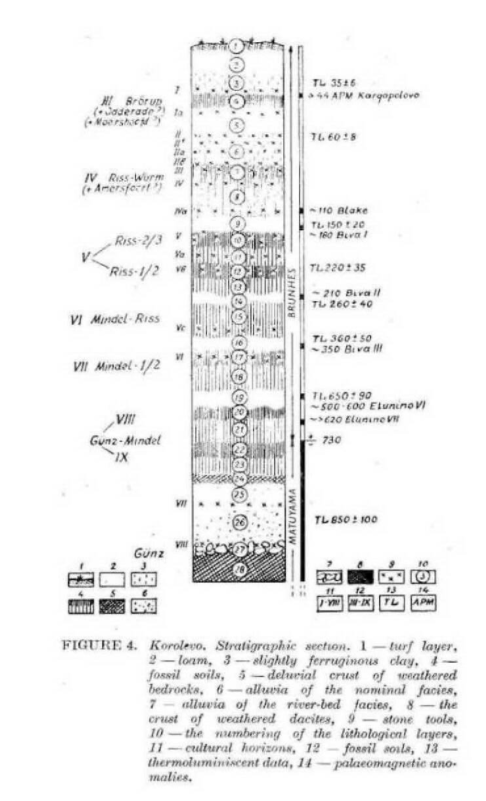
One of the oldest sites in Central and Eastern Europe — and one of the largest in Europe — is the Korolevo site, dating back approximately 1 million years [15]. It belongs to the Early Paleolithic period. The site was discovered on a hill 120 meters high in the upper Tysa River basin, in the village of Korolevo, Zakarpattia region. It is the oldest site in Eastern Europe and marks the beginning of human settlement in this part of the European continent and the start of human history in Ukraine.
Stone tools of early humans were found at Korolevo: axes, scrapers, points, burins, choppers, and knives. In a 12-meter layer of loam, archaeologists identified 16 cultural layers with traces of material culture from several Paleolithic epochs. The number of finds reaches approximately 100,000 items, including tools of Cro-Magnons, Neanderthals, and Pithecanthropus. [1, 2, 3, 5, 6]

These findings belong to the Acheulean period — an archaeological culture of the early Paleolithic stage (1.7 million – 150,000 years ago). Although the name originates from Saint-Acheul, a suburb of Amiens on the Somme River in northern France, the archaeological finds there are significantly younger than those at Korolevo.
During Soviet times, a gravel plant was built directly on the territory of the Korolevo archaeological site.
The Kyiv-Kyrylivska Site
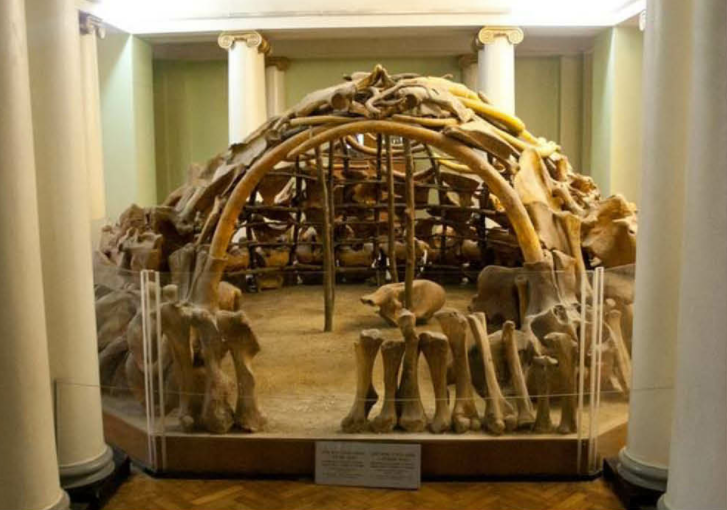
The Kyiv-Kyrylivska site is dated by various sources to 19,000–25,000 years ago. In Kyiv, in the Podil district near the Kyrylivska Church, fragments of a mammoth tusk were discovered. Further excavations revealed several cultural layers.

“The upper cultural layer (excavation area of 600 m²) consisted of circular features in plan (2 m in diameter, 5–10 cm thick) with remains of hearths, flint tools (about 300 specimens), and bones of cave bear, wolf, wolverine, and hyena. These clusters (around 20 in number) were arranged in a nest-like pattern and aligned in a row.” These are considered the remains of dwellings of people who lived here during the Paleolithic period.
“The Kyiv-Kyrylivska site immediately gained fame due to its unique works of art — ornamented mammoth tusks. These include a fragment with incised linear ornamentation (similar to scale markings) and a fragment with an engraving. The composition includes zoomorphic images (in profile): a mammoth, a long-beaked bird (stork or crane), and a turtle. Numerous hypotheses exist regarding the meaning of these images. Scholars interpret them as representations of the three elements surrounding early humans — earth (mammoth), air (bird), and water (turtle).” [4, 8, 16]
Fate of the Collection
“The fate of the Kyrylivska collection is also noteworthy. A small part of the finds was selected by French researchers and taken to France. Today it is preserved at the National Museum of Archaeology in Saint-Germain-en-Laye.” [6, 10]
According to Tetiana Radiievska, senior researcher of the Stone–Bronze Age Archaeology Sector of the National Museum of the History of Ukraine: “In the 1970s, NMHU collection specialists T. H. Movsha and O. O. Yakubenko, using pre-war publications and old inventory numbers, restored to science the undocumented materials of the Kyrylivska site returned from Germany.” [6, 10]
The same cannot be said about the aggressor country Russia — a global leader in violations of academic integrity. During World War II, the collection was evacuated to Ufa, Russia [17]. As is widely known, Russian “scholars” continue to present artifacts found in Ukraine as Russian discoveries.
We hope that through the efforts of the global scientific community, Ukraine will reclaim its history and cultural heritage.
Glory to Ukraine!
References
- K. Kris Hirst, Molodova I (Ukraine), 03.2019, https://www.thoughtco.com/molodova-i-ukraine-paleolithic-site-171818
- Demay L, Pan S, and Patou-Mathis M. in press. Mammoths used as food and building resources by Neanderthals: Zooarchaeological study applied to layer 4, Molodova I (Ukraine). Quaternary International.
- Meignen, L., J.-M. Genest, L. Koulakovsaia, and A. Sytnik. 2004. Koulichivka and its place in the Middle-Upper Paleolithic transition in eastern Europe. Chapter 4 inThe Early Upper Paleolithic Beyond Western Europe, PJ. Brantingham, S.L. Kuhn, and K. W. Kerry, eds. University of California Press, Berkeley.
- Т. М. Р а д і є в с ь к а. Археологія у науковому доробку Хведора Вовка, матеріали його досліджень у зібрання Національного музею України. УДК [902(091):069.5](477-25)
- L. Demay, P. M. Vasylev, L. V. Koulakovska, D. V. Stupak, P. S. Shydlovskyi, V. I. Belyaeva. Palaeolithic human societies during the upper pleniglacial period and their connections with the animal world according the evidence from archeological sites of Ukraine. 82 ISSN 2227-4952 (Print), ISSN 2708-6143 (Online). Археологія 1 давня історія України, 2020, вип. 4 (37)
- Baye Joseph de, Volkov Theodore. Le G isem ent paleolithique d’Aphontova-Gora – Paris, 1899.
- Яковлева Л.Нові дані про археологічні колекції В. Хвойки з Кирилівської стоянки // АНТ. Вісник архео-логі, мистецтва, культури. – 2000, – Nº4-6. – С. 96.
- С. А. Сорокіна, Т. М. Р а ді є в сь к а, О. М. Завальна, KIYV ARCHAEOLOGICAL COLLECTIONS UNDER THE CONTROL OF GERMAN ADMINISTRATION IN THE FIELD OF ARCHAEOLOGY 1942-1945). УДК 069(1-4) +94:902(477-25) + 930.25″1942/1943″
- Pawlo Shydlovskyi, Dmytro Stupak. THE RESEARCH OF FLINT IMPLEMENTS ON KYRYLIVSKA SITE. Y Д К 903.4(4-11 + 477.6)”632.5″
- Tresors meconnus du Musee de 1 ‘Homme. Dans le secret des objets et des mondes / Catherine Eveeds. / Museum National d’Histoire Naturelle. – Paris, 1991. – 180 p.
- Хвойко В.В.Каменный век Среднего Приднепровья // Тр. XI Археологического съезда.- Т.1.- М., 1901-C. 736-754.
- Хвойко В.В.Киево-Кирилловская палеолитичес-кая стоянка и культура эпохи мадлен // Археологичес-кая летопись Южной России.- Т.1 (1903).- К., 1904.- С. 26-57.
- Волков Ф.К.Искусство мадленской эпохи в Украине // Археологическая летопись Южной России.- Т.1 (1903).- К., 1904.- C. 19-21.
- Борисковский П.И.Палеолит Украины // МИА.- Nº 40.- M.- Л., 1953.- C. 160-174.
- Larissa. Kulakovska, Vitaly Usik. Early Paleolithic of Korolevo site (Transcarpathia, Ukraine). Quaternary International223:116-130. DOI:10.1016/j.quaint.2009.09.031
- Pavlo Shydlovskyi. Дослідження кремʼяного інвентарю Кирилівської стоянки / Investigation of flint inventory of Kyrylivska site. December 2012. DOI:10.5281/zenodo.1202188
- Nathalie Richard Volkov in France: Cultural Transfers in Anthropology and Prehistoric Archaeology at the End of the 19th Century.Le Mans Universit. January 2012.
- Oleksandr Naumenko. The Iskorost Site and its Place in the Stone Age of Ukraine: Historiographical, Typological and Technological Aspects. September 2022.Arheologia DOI:10.15407/arheologia2022.03.088
The use of information and quotations is permitted only with proper attribution to the author of the article.
Liudmyla Vesper
France