When we speak of a “state of temporariness” in the context of Russia’s full-scale war against Ukraine, at first glance it seems that we are referring to something entirely clear. Something that requires no further clarification. And it is precisely for this reason that the concept slips away from us, seeming too obvious to be fully grasped.
Text by Daria Lysenko, writer
This sense of something not being obvious precisely because it is so obvious became central to my experience of Marianna Dzhulai’s exhibition State of Temporariness, which opened in late April in Aalsmeer, the Netherlands. Rather than offering an answer, the exhibition seemed to return me to the question itself: what exactly do we mean when we use this phrase?
For millions of Ukrainians living under temporary protection in different countries, “temporariness” has a very concrete dimension. It is formally enshrined in temporary protection documents. Yet, at the same time, this formal status has gradually transformed into an existential condition — a way of being in the world where certainty is constantly deferred.
One might expect this very experience to become the dominant focus of the curatorial concept. Yet the exhibition demonstrates that a “state of temporariness” need not be a universal category, even when it appears to describe a shared reality.
For Ukrainian refugees, a state of temporariness is the experience of prolonged waiting for an unattainable sense of certainty, in which time ceases to be linear and instead resembles a delay, a pause with no clearly defined end.
For a Dutch viewer, it may offer a different perspective: temporariness as a period of hospitality, an interim state preceding a return to a supposedly “normal” life.
For Dutch artists observing this situation from the outside, it may already be a defined, and perhaps even partly concluded, fragment of reality following the beginning of the full-scale invasion in 2022 — a fragment that can be reflected upon as an event belonging to the past.
For artists who remain in Ukraine, “temporariness” may take on a different meaning: an attempt to capture the fragile, unstable moments of a life unfolding under constant threat.
And finally, for a Ukrainian artist forced into migration, it is often a state of being “in between” — between places, languages, and contexts, none of which becomes definitive.
Thus, at first glance, the exhibition seems not so much to consolidate meanings as to multiply them. It breaks down the “state of temporariness” into a series of distinct experiences that cannot be reduced to a common denominator, yet coexist, sometimes intersecting and sometimes remaining parallel.
But I came to understand that this was not the case.
First, what unites these different perspectives is that temporariness is almost never understood as a neutral condition. It implies incompleteness and vulnerability. It always points towards something that is supposed to change.
In this sense, “temporariness” becomes not merely a description of a condition but also a form of waiting. To be precise, waiting for the war to end.
Second, the “state of temporariness” has an even more concrete and universal meaning, one that is obvious to everyone yet remains unspoken because it is frightening to say aloud:
It is a state of survival.
Everyone who has stayed in Ukraine or decided to leave the country is not simply waiting for the war to end as if it were some abstract event. These are people living in a state of perpetual survival amid the genocide of the Ukrainian people that Russia perpetrates every day. In 2022, Russia chose to occupy Ukrainian territory in its entirety, and it continues its daily terror through shelling attacks on civilians, the torture of prisoners of war, and the killing of Ukrainians whose bodies are buried in mass graves in occupied territories.
So, what states of temporariness — in other words, states of survival — do we see in the works presented by the women artists?
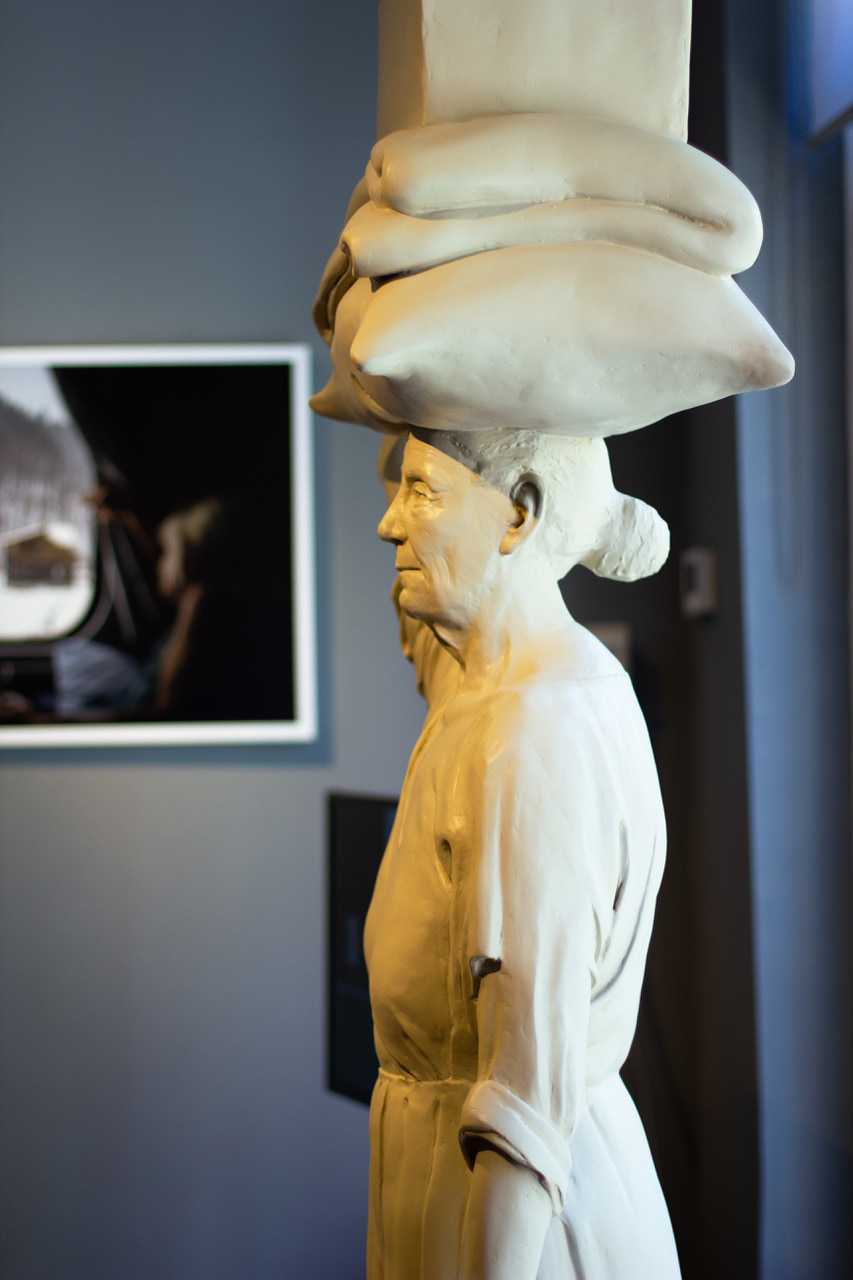
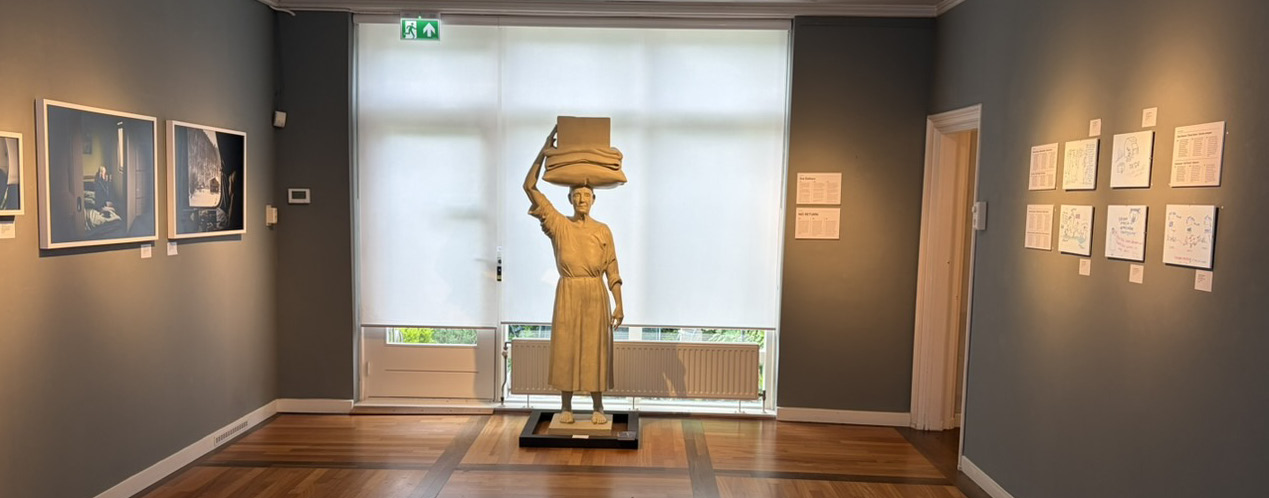
Dutch artists Ilse Olbers and Marijke Greve focus their sculptures on the moment of the evacuation of Ukrainian refugees at the beginning of Russia’s full-scale invasion of Ukraine in 2022. More specifically, they focus on the material objects Ukrainians carried with them: small bundles of belongings or the clothes a refugee happened to be wearing when setting out from home into the unknown.
This is interesting because we might assume that a person who has never experienced displacement but imagines themselves in such a situation would first ask: “What would I take with me?”
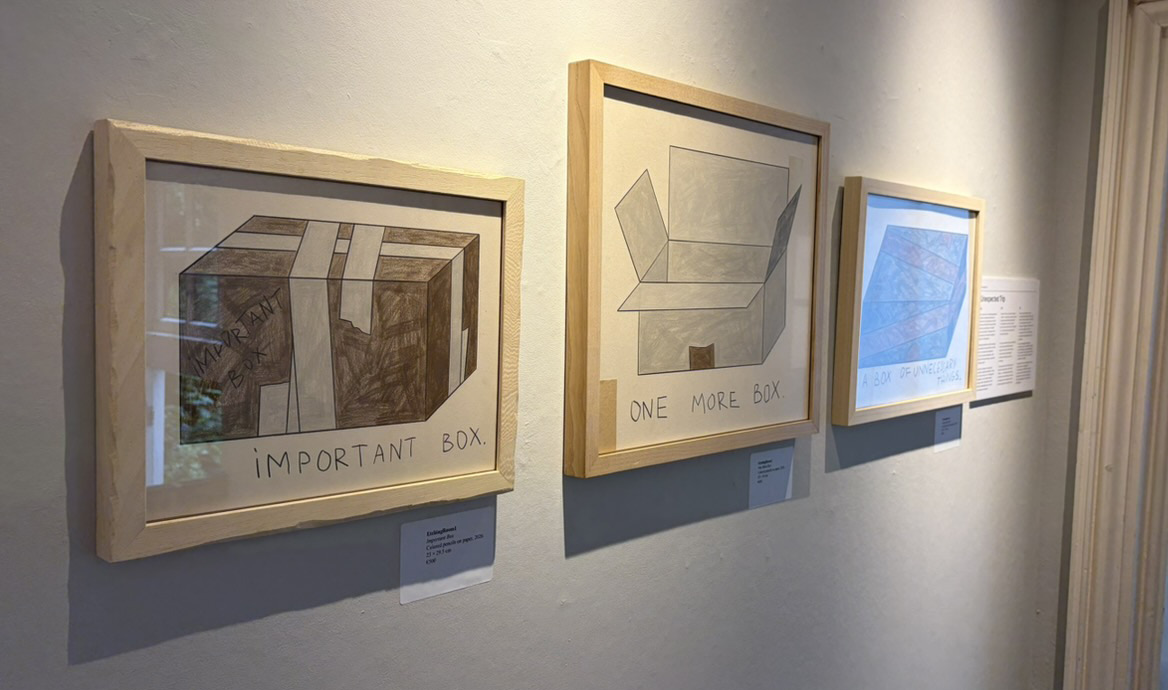
Ukrainians, by contrast, tend to be more indifferent to this question or approach it with irony. The artistic duo EtchingRoom1 (Khrystyna Yarosh and Anna Khodkova) illustrates this beautifully in their triptych Unexpected Journey, which consists of images of three boxes: An Important Box, Another Box, and A Box of Unnecessary
Things. In wartime, material possessions turned out to be the least important thing of all. Even those who had time to take something with them during evacuation often ended up bringing things that had simply lost their value and usefulness in the context of war.
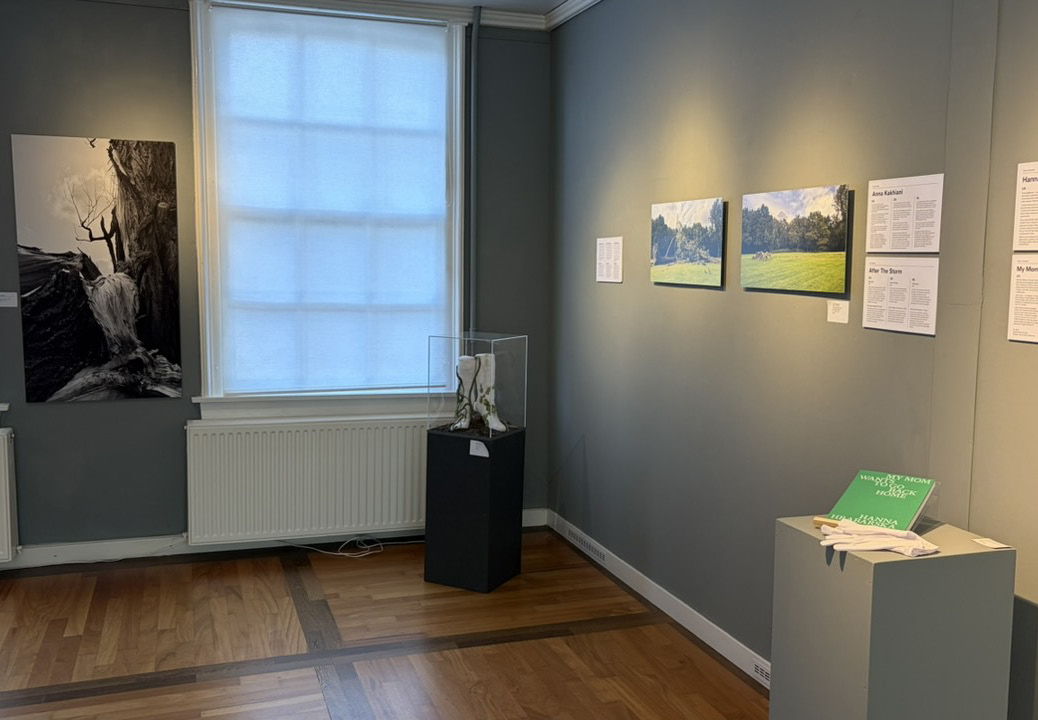
The loss of material value is also evident in the photographs by Hanna Grabarska, who documented the journey she made with her mother from Kryvyi Rih to the Netherlands, as well as their arrival. At this most critical moment, her gaze is fixed on the person dearest to her — her mother — and on the stoicism with which she endures one of life’s most tragic events: the loss of normality and the arrival of war at her doorstep.
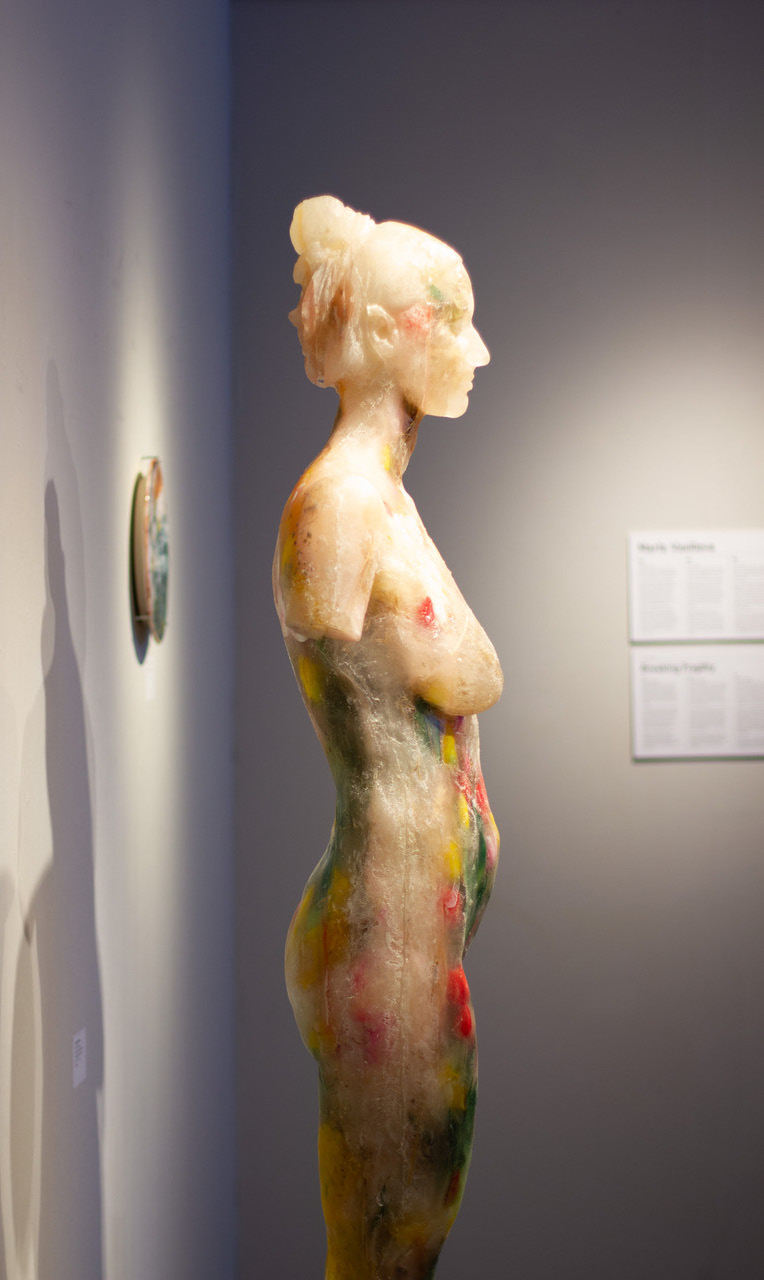
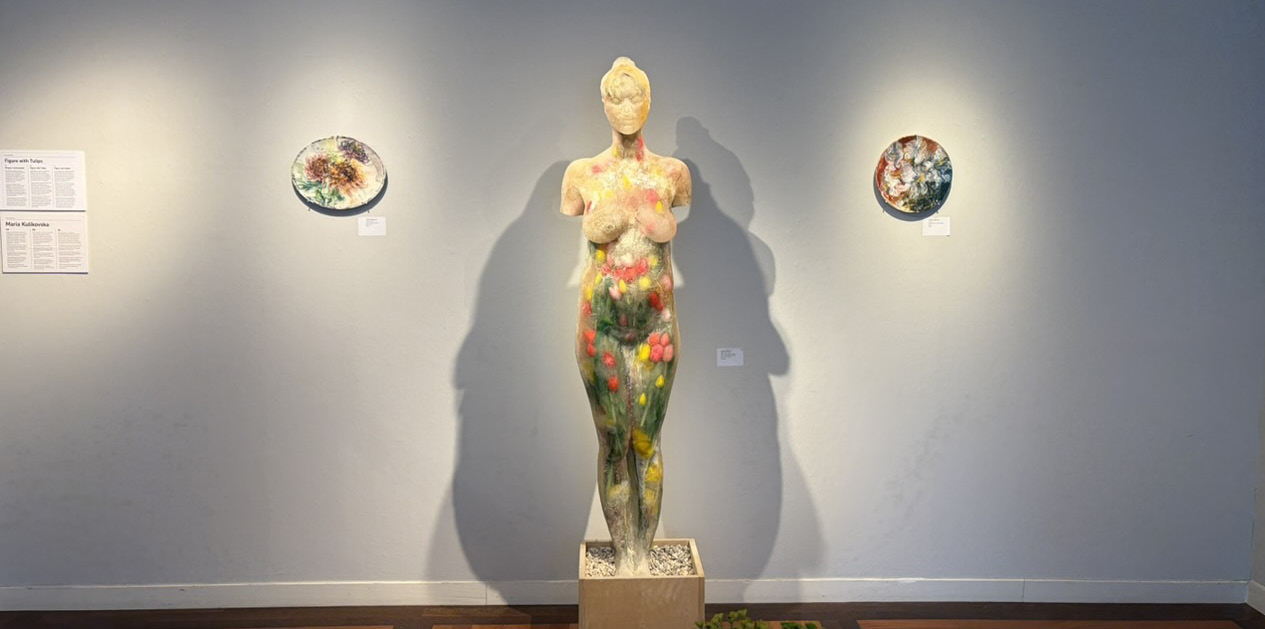
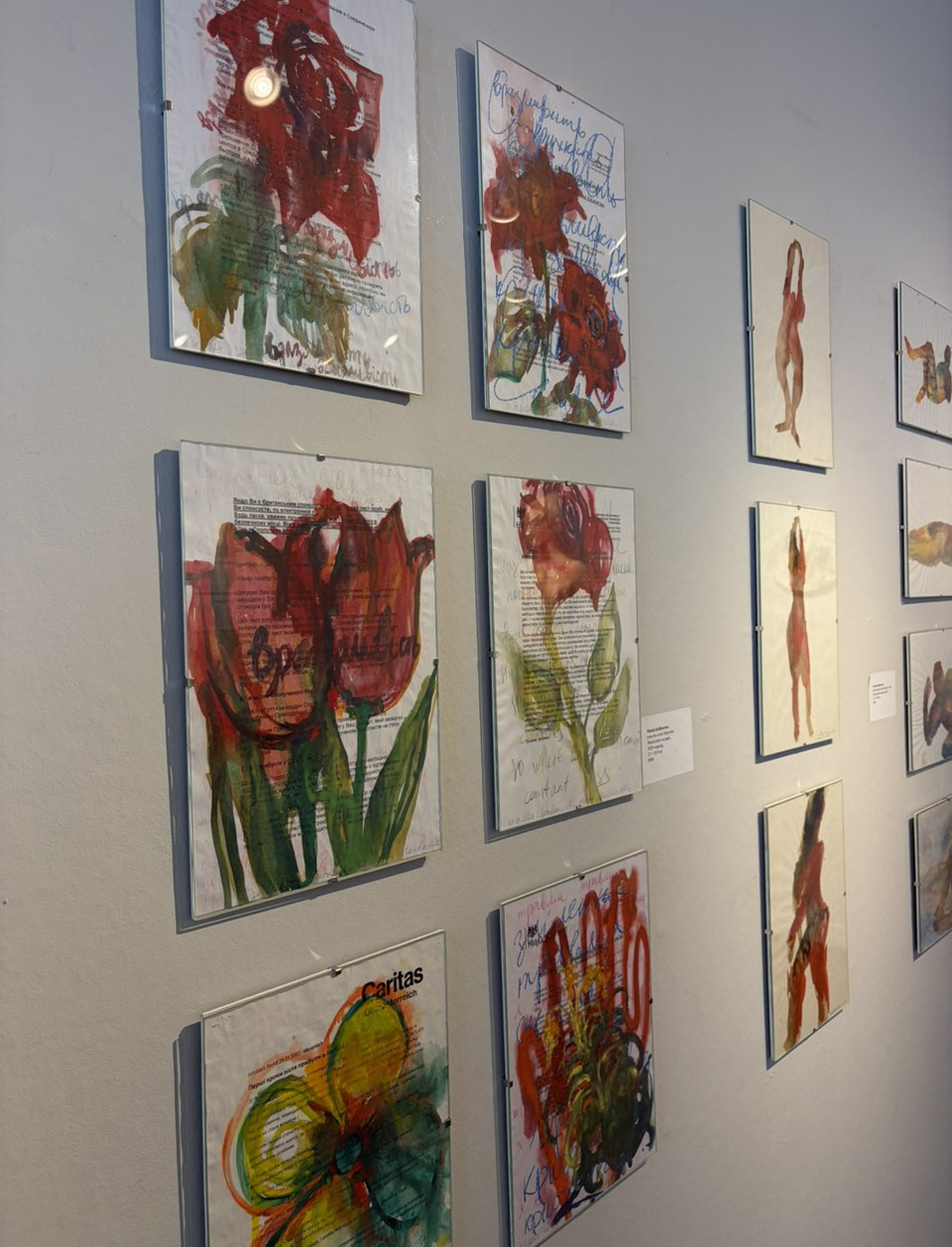
In Maria Kulikovska’s work, the material is represented quite literally by a cast of the artist’s own body, made in transparent resin with tulips and medicinal herbs embedded inside. This transforms the body, in the curator’s words, “into an archive of time, emotions, trauma, and hope.” In other words, amid the genocide of the Ukrainian people and the full-scale war, the most precious things a person can preserve are their own life and the lives of those closest to them.
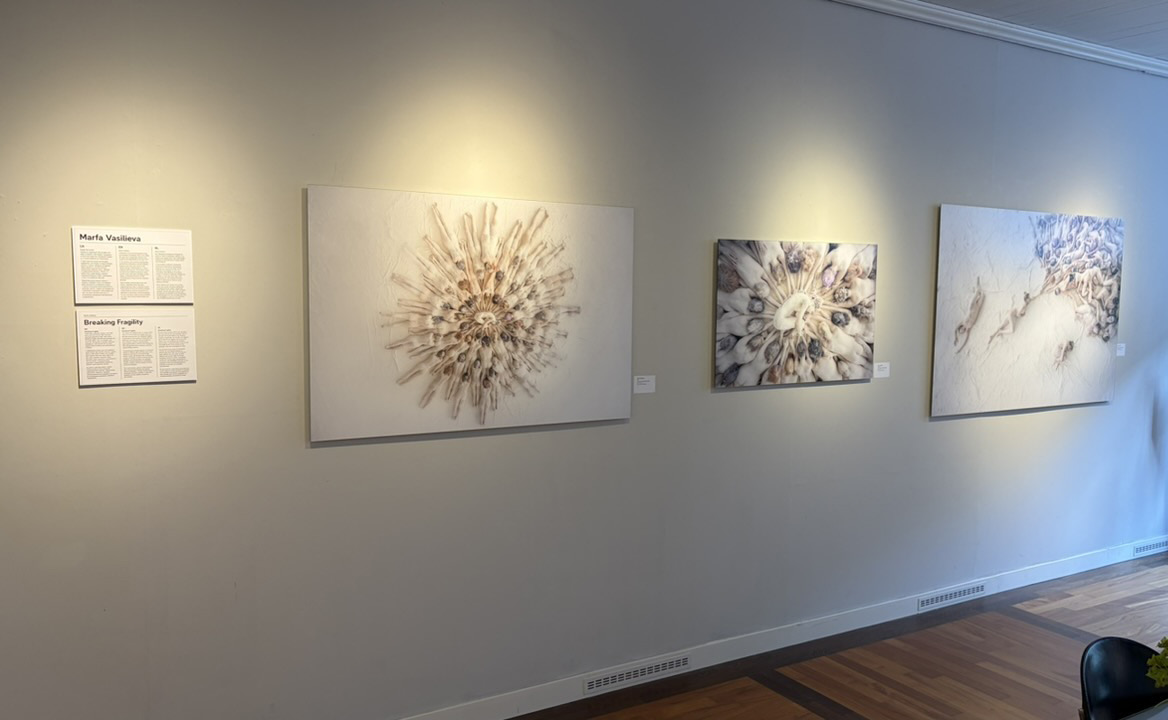
 As is well known, the majority of refugees who fled Ukraine in 2022 were women. This was also what prompted the curator to bring together different female artistic perspectives in the exhibition. This sense of sisterhood and solidarity is particularly palpable in Marfa
Vasylieva’s photographic series Breaking Fragility, documenting a performance involving 63 Ukrainian women. The participants were invited to live through their own stories using their bodies, movement, screams, and breath. In this way, the artist speaks of women supporting one another, both within families across generations and throughout society, as we face some of the most difficult challenges of our time.
The artist Anna Kakhiani also speaks of the body as material, but through metaphor. In her photographic diptych, we see a tree uprooted in Amsterdam’s Sloterpark after Storm Poly in 2024, followed by an image of the same tree cut into pieces. The work bears the evocative title Flesh.
“These images reflect how society and the individual respond to what is broken, damaged, or unsettling. The uprooted tree was cut into pieces and quickly removed from view,” we read in Dzhulai’s curatorial text.
A chilling realization sets in: a body rescued from war, labelled with the negatively charged word “refugee,” is itself uprooted — not only physically but also emotionally — and may, undoubtedly, be broken. Such a body can be unsettling to a society that has not faced the challenges of war.
That tree is me, a Ukrainian refugee, and looking at this photograph makes me feel physical pain. Are we really such an inconvenience to society? The question freezes inside me, unanswered.
War, suffering, and the experience of being a refugee are genuinely uncomfortable and painful subjects. When given the opportunity to turn away and look elsewhere, a person instinctively wants to do just that when confronted with them — even if these horrors are not part of their own life but are encountered in an exhibition space. And this can be painful for us as Ukrainians, too, because we want to be seen and heard. Turning away from horror is a natural reaction, and however unpleasant it may be for me, I can understand it.
What matters more to me is that we do not turn away from the reason why we, as Ukrainians, find ourselves in this state of temporariness — or, more precisely, this state of survival.
Alevtina Kakhidze captures this brilliantly in her work Sincere Wishes. It depicts three groups of people who do not want war. Europeans who do not want war sit at café tables; Ukrainians who do not want war defend themselves, shelter in bunkers, and suffer from missile attacks; Russians who do not want war shoot and kill Ukrainians.
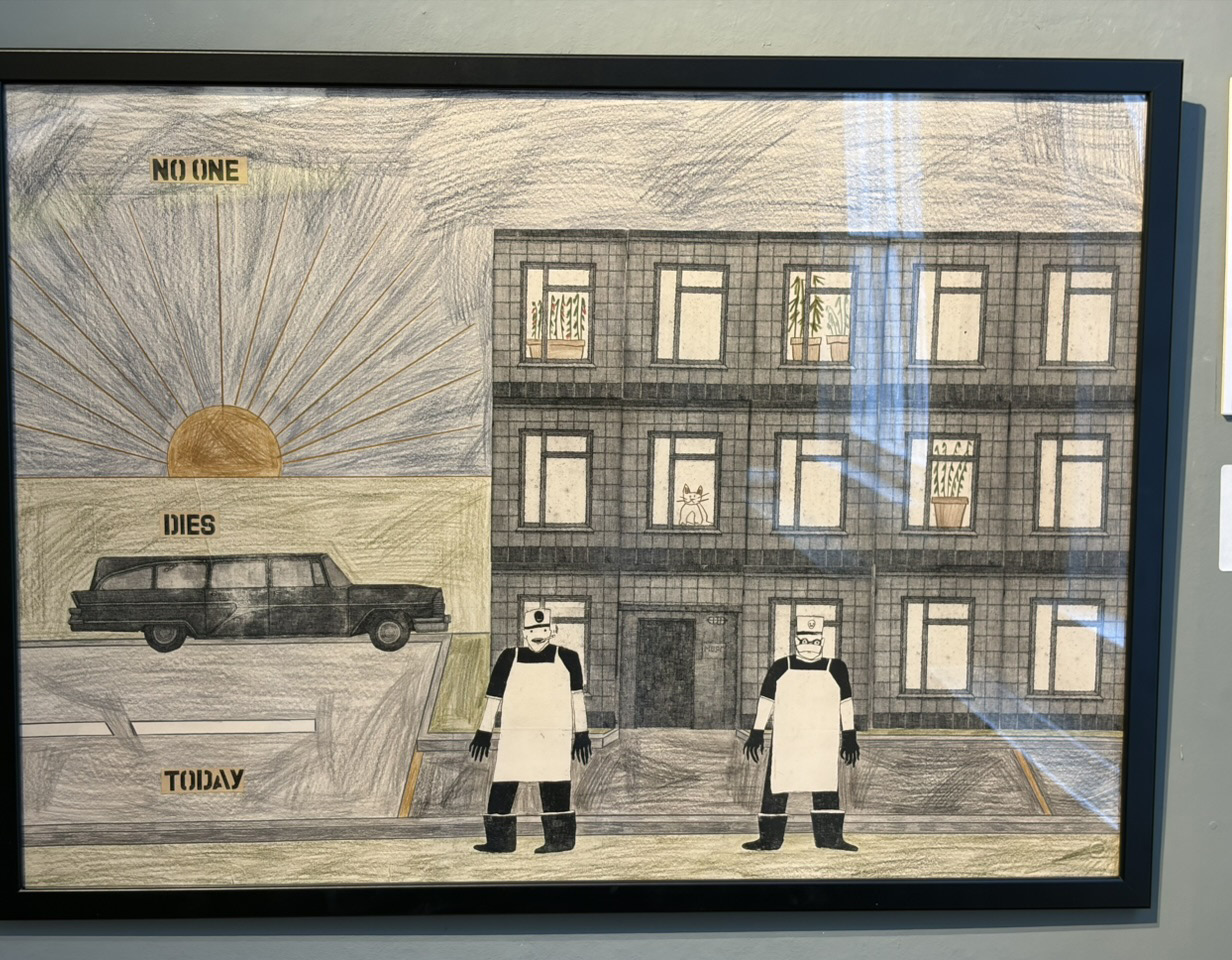
Throughout the exhibition, two gazes from another work by EtchingRoom1 stay with me. They belong to two morgue workers who are smoking and staring straight ahead, their pupils rendered as four tiny dots. They have nothing to do. “Today, no one has died,” the work reads.
I feel deeply unsettled by the realization that THIS, precisely, is what the temporary state is.
But do all the exhibition’s visitors understand this?
Almost automatically, I open a notification on my phone. I read that today, on the day the exhibition opened, April 25, Russia continued its missile attacks on a residential neighbourhood in Dnipro, both overnight and during the day. One person killed, 46 injured, including five children. When was the last day in Ukraine when “today, no one has died” at the hands of the Russians? It is difficult to remember.
So how can we convey THIS PARTICULAR state of temporariness through art?
As a writer, I have no choice but to say it plainly, as it is: As a people, and as individuals, Ukrainians are doing everything they can to survive.
Please, do not look away.