
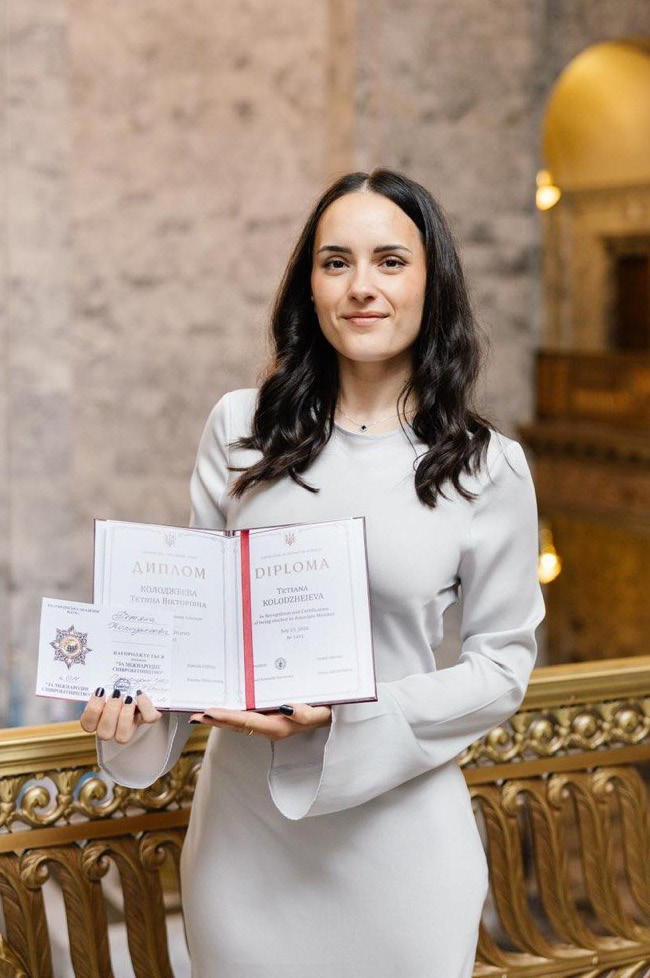
A member of the Academy of Sciences of Ukraine, inventor, creator of SyncBeat™, and entrepreneur, she is building professional recognition, international partnerships, and the development of Ukrainian innovation in the United States.
Today, she is known as an inventor and entrepreneur developing SyncBeat™ in the United States and internationally. Recently, her professional journey received another important recognition — she became a member of the Academy of Sciences of Ukraine.
Her professional path has brought together choreography, education, working with children, technology, science, and entrepreneurship. It is at the intersection of these fields that SyncBeat™ is being developed — a tactile synchronization system that uses vibration as an additional way of experiencing rhythm and movement.
Today, the project is developing not only in the United States. Its creator is building international partnerships and already has professional agreements and collaborations in several European countries. We spoke with her about professional recognition, the development of SyncBeat™, international cooperation, and the future of Ukrainian innovation.
1. You recently became a member of the Academy of Sciences of Ukraine. What did you feel when you received this recognition, and what does it mean to you personally?
For me, it was a very important professional recognition. I felt very proud — not only of myself, but especially of my work and SyncBeat™, into which I have invested a great deal of knowledge, effort, and energy.
What is especially meaningful to me is that my work received professional and scientific recognition and that it has the potential to be useful to society, particularly to children.
2. Your work has also received other professional distinctions. What do they mean to you?
Among my professional recognitions, the Order “For International Cooperation” holds a special place for me. I see it as confirmation that I am moving in the right direction — connecting Ukrainian innovations with international opportunities and creating professional relationships between Ukraine and the rest of the world.
Recognition in the field of innovation and invention for my work on SyncBeat™ has also been important to me. I value the fact that not only the idea itself was recognized, but also the work involved in turning it into a practical solution.
For me, these recognitions are primarily motivation to continue developing SyncBeat™ and not stop at what has already been achieved.
 3. You also became a member of the International Association of Scientists “Intellectual Leadership”. What does this membership mean to you?
For me, it is an important stage of professional development and an opportunity to be part of an international scientific community. I enjoy communicating with people from different fields, exchanging experiences, and discovering opportunities for new cooperation.
I also see it as an opportunity to gain new knowledge and develop SyncBeat™ not only as a business project, but also as a technology with scientific and practical value.
4. You are developing SyncBeat™ internationally, but the Ukrainian market remains important to you. What potential do you see for this technology in Ukraine?
I see potential for SyncBeat™ in Ukraine primarily in education, inclusive programs, dance, and sports. It is especially important to me that children with different educational needs have more opportunities to participate in group activities, interact with others, and develop through movement and rhythm. I believe this is important for their emotional, mental, and physical development.
However, the potential of the technology is much broader. Because of the war, many Ukrainian defenders need physical and psychological rehabilitation. In the future, I would like to explore the possibility of using SyncBeat™ as an additional tool in such programs — for movement, rhythm, coordination, and social interaction.
It is important to me that the technology can help people gradually return to an active life and become more engaged in society.
5. One of the areas of your international activity is your cooperation in Spain. How is it developing, and what opportunities does it create for SyncBeat™?
The cooperation in Spain has become one of the steps in the international development of SyncBeat™. I signed an agreement with Marianna Moskalenko for the use of my technology, creating an opportunity to represent and use SyncBeat™ in Spain.
This is important for SyncBeat™ because every new international connection gives us an opportunity to see how the technology can work in a different professional environment, gain practical experience, and discover new areas of application.
6. You are also developing professional cooperation in the Netherlands and England. What opportunities does this create for SyncBeat™?
For me, working with children is especially important. Through international professional cooperation, I have the opportunity to explore the practical use of SyncBeat™ in different environments.
For example, I met Olga Anatoliivna Anisimova during a meeting of honorary members of the International Association of Scientists “Intellectual Leadership”. Olga works in business consulting in the United Kingdom, and during our meeting she became interested in my professional experience and the innovative SyncBeat™ project. I value these professional connections because they open new opportunities for the development of the project.
Cooperation in the United Kingdom and the Netherlands allows me to explore the practical use of SyncBeat™ in education, dance, movement-based activities, and inclusive programs.
One of the important advantages of the technology, in my opinion, is that a tactile signal does not depend on language. A child does not necessarily need to understand the same language as a teacher or other children in order to feel the rhythm and understand the signal through vibration.
This is particularly important in international and inclusive environments. I want to explore how SyncBeat™ can help children better feel rhythm, coordinate their movements, interact with others, and become more engaged in group activities. In the future, international cooperation can become an important step toward practical testing, improvement, and scaling of SyncBeat™.
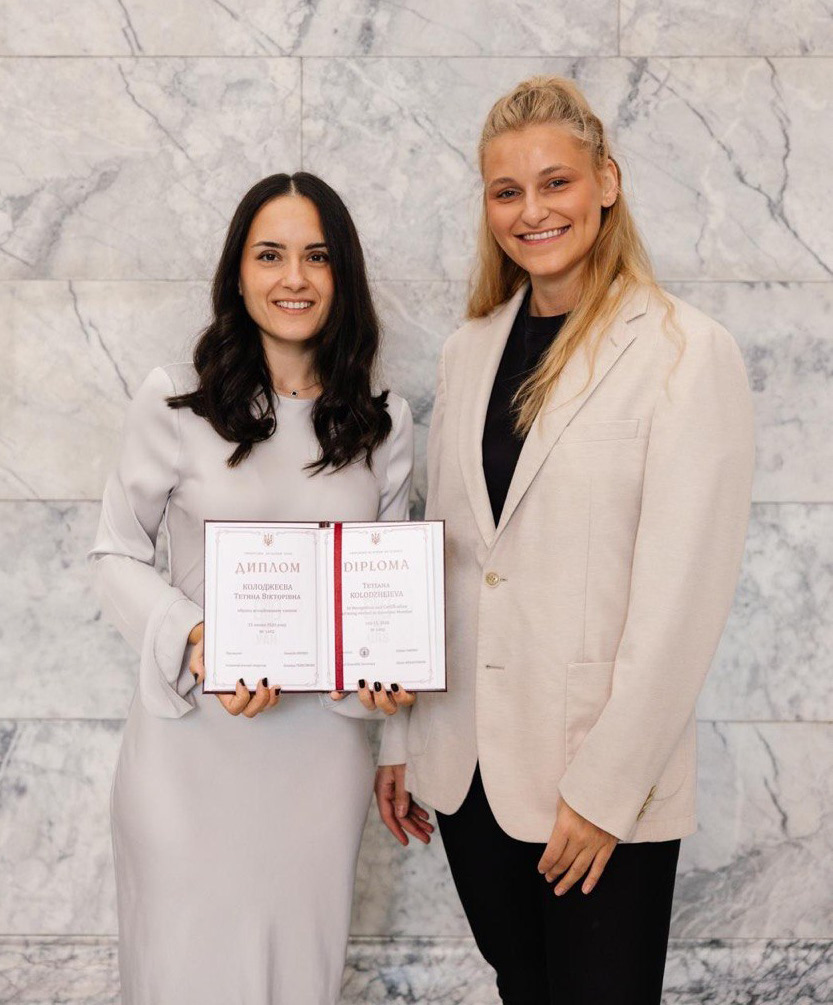 7. You have already entered the international market. Tell us more about your international cooperation and which countries are currently of interest to you.
Yes, today SyncBeat™ is gradually expanding internationally. I am already developing professional contacts and cooperation in Ukraine, Poland, Spain, the Netherlands, England, and Germany.
For me, this is not simply about presenting my invention in other countries. It is about finding partners, exchanging experience, and exploring new ways to apply SyncBeat™ together.
I am interested in working with people and organizations in education, dance, inclusion, sports, and rehabilitation. I want the technology to be tested in different countries and to receive professional feedback.
I am particularly interested in Latin America. The region has a very strong culture of music, dance, and group interaction, and my own professional journey began with choreography and working with children. I therefore see interesting opportunities there for future partnerships and joint projects.
For me, international development is not simply about entering new markets. It is about building a network of people and partners with whom SyncBeat™ can continue to grow.
8. Today, you are developing a Ukrainian innovation in the United States. What have you learned about the American professional environment, and what opportunities do you see for SyncBeat™?
Entering the American market has shown me how professional, open, and dynamic this environment is. I currently work in early childhood education in the United States, which gives me the opportunity to work directly with American children, observe them, and better understand their behavior, needs, and learning styles.
This experience is very valuable for the development of SyncBeat™ because I can see the children’s environment from the inside rather than thinking about the technology only theoretically.
I particularly value the attention given in the United States to children, education, and inclusion. I see significant potential for SyncBeat™ in these areas and want the technology to develop through practical experience, research, and international cooperation.
9. What inspired you to create SyncBeat™, and how did your experience in choreography and working with children influence the development of the technology?
The idea for SyncBeat™ grew largely from my professional experience in choreography, teaching, and working with children. My work showed me how important rhythm, movement, and the opportunity for every child to be part of a group can be.
I wanted to find a way to make music, movement, and learning more accessible. That is how the idea of using vibration as an additional way of experiencing musical rhythm and movement gradually emerged.
I was especially interested in helping children who cannot fully experience music through hearing find another way to feel it through their bodies.
10. What was the most difficult stage in turning the idea into a real technology?
The most difficult part was turning the many ideas that initially existed only in my head into one clear concept and then into a real technology and methodology.
I had to understand how one application could transmit synchronized signals to multiple bracelets, how musical rhythm could be transformed into vibration signals, and how a person could understand through those signals when to change a movement or rhythm.
So it was not simply about creating a device. I had to develop an entire system that would be understandable and practical for the user.
That process — moving from many ideas to one clear, functioning system — was one of the most challenging stages for me.
11. If you had to explain in simple terms, what exactly does SyncBeat™ do?
The main idea behind SyncBeat™ is to help people experience music and rhythm through vibration and synchronize their movements with others.
The bracelet provides a tactile signal that a person feels through the body. For children with hearing difficulties, this can be much more than simply helping them perform movements. It can provide another way to experience music itself — to feel its rhythm through the body and participate in shared musical and movement activities.
At the same time, the technology is not tied to a specific language, which makes it interesting for both international and inclusive environments.
12. How do you see the practical value of SyncBeat™ for education, inclusion, sports, and rehabilitation?
I see the practical value of SyncBeat™ as much broader than simply synchronizing movements. In education, the technology can help children better feel rhythm, coordinate movements, and participate in group activities.
In rehabilitation, it could potentially serve as an additional tool for working with movement, coordination, and physical recovery.
The social aspect is also very important to me. When a person moves together with others, feels a shared rhythm, and interacts with a group, it can create additional opportunities for socialization and communication.
That is why I see SyncBeat™ as a technology that could potentially support people’s physical, emotional, and social development.
13. Your work combines education, choreography, technology, science, and entrepreneurship. How do these fields complement each other?
For me, all of these fields naturally complement one another. Choreography gave me an understanding of movement and rhythm, while education and working with children gave me an understanding of how people learn and interact.
Technology and science help transform these observations into innovative solutions, while entrepreneurship helps develop and scale them and find opportunities for practical application.
SyncBeat™ is being developed precisely at the intersection of these fields.
14. What do you see as the next stage in the development of SyncBeat™ and K-MOVEMENT?
The next stage for me is to scale what has already started to develop. Today, SyncBeat™ is already moving beyond a single market: I have partnership agreements and contracts in Spain, England, and the Netherlands, while also developing the project in the United States.
I want to continue expanding geographically, finding new partners, and gradually entering new international markets.
It is important to me that SyncBeat™ finds applications in education, inclusion, dance, sports, and rehabilitation. In the long term, I would also like to create a social project that helps make inclusive technologies more accessible to more children and people who need them.
For me, it is important that SyncBeat™ has not only commercial value, but also social value.
15. What would you like to say to young Ukrainian inventors and innovators who have an idea but are afraid to take the first step?
I would say: do not be afraid to start, even if your idea seems imperfect today. Every great project once began with a first step.
It is important to believe in your idea, while also being willing to learn, listen to others, accept criticism, and continuously improve it.
My own journey is an example that an idea can travel from choreography and working with children to technology, international cooperation, and professional recognition. So I would encourage young inventors not to be afraid to think big, but at the same time to take concrete steps toward their goals.

